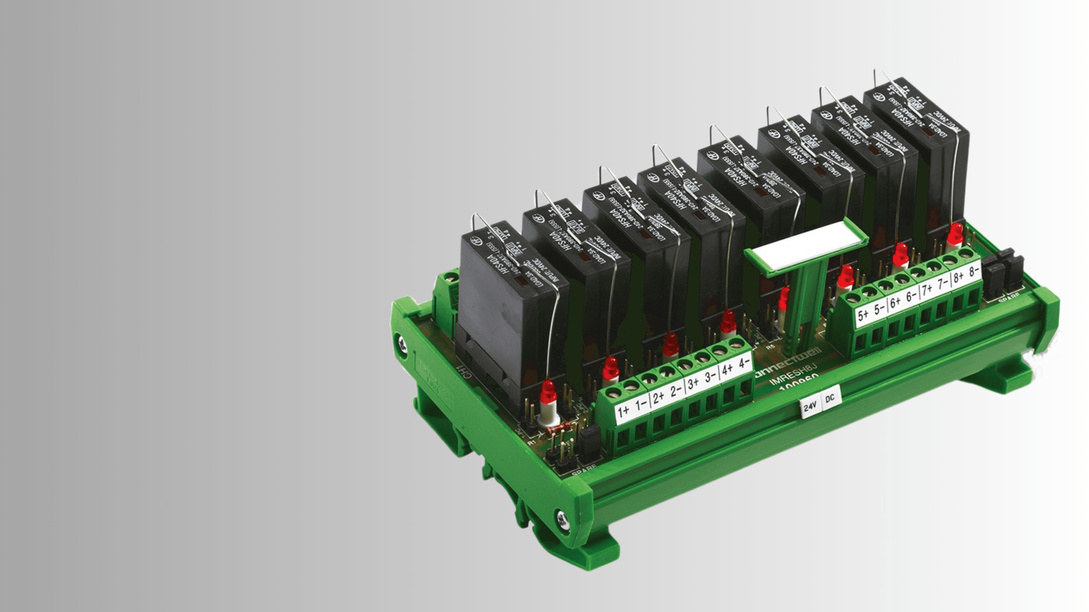
Why are Solid State Relays used?
Solid State Relays (SSRs) are electronic switching devices that by their nature contain no moving parts. The absence of mechanical or physical movement for switching is a major advantage over electromechanical relays. Below are the main advantages of solid state relay modules:
1 - High operating frequency
2 - Operations without contact tremors
3 - Extended service life
One of the main advantages of having no moving parts is that SSRs offer very fast response times, without the problems of contact "bounce" and without mechanical noise. The application of the command signal to the control circuit and the activation of the output circuit usually occur within microseconds.
A quick look at the circuit diagram shows how a typical Solid State Relay module contains two terminals, one for input and one for output. Typically, Solid State Relays use Optocoupler-based switching, which ensures isolation between input and output.
DC-AC Configuration
In this configuration, the input is always DC and the output is AC. The input circuit operates on a DC circuit, while the switching load is of the AC type. On the input side, there is a polarity, but it is not necessary to check the polarity if a DIAC-based circuit is used for switching.
DC-DC Configuration
In this configuration, both the input and output currents are DC, both with polarity requirements. If a voltage other than DC is applied, the relay may be damaged. The DC input is applied to the optocoupler. At the output, DC switching is used for the loads.
AC-AC Configuration
Optocouplers always operate on DC voltage, not AC voltage. Therefore, in this type of relay, the power is first rectified to DC and then applied to the optocoupler for switching. At the output side, the AC load is connected.
AC-DC Configuration
In this configuration, a rectifier circuit is used at the input. At the output, a DC switching circuit is used to switch the load.


Today, Solid State Relays (SSRs) find applications in virtually every industry due to their high responsiveness and low power consumption during actuation. They are typically used in spaces similar to electromechanical relay modules for switching, protection and switching applications.
Solid State Relays are applied in:
1 - Load Switching
2 - DI/DO Protection
3 - Isolation between Input and Output
Industrial segments where Solid State Relays are used include:
1 - Applications in DCS
2 - Solenoid valve keying
3 - Highly inductive load components such as motors
4 - High frequency switching, such as printers
5 - Control of lights, fans and similar devices
6 - Lines of communication
For new industrial applications or upgrading to a more modern standard, Connectwell solid state relay modules offer highly responsive performance with greater accuracy in supplying and removing power to the load. Choosing solid state relays over electromechanical relays offers advantages such as high frequency switching, switching of highly inductive loads, and zero crossing switching.
Connectwell, your right connection partner
With more than 15 international product certifications backed by the most stringent quality standards, our products pass through more than 40 quality assurance tests. This has ensured a ready acceptance of Connectwell terminal blocks across 80+ countries and in thousands of projects and applications worldwide.
Through our 4 decades of experience with state-of-the-art operations which are ISO certified, Connectwell has grown to become one of the leading manufacturers of terminal blocks in the world.
More than 1 million connections are made every day across the globe with Connectwell terminal blocks, making Connectwell a synonym for… the right connection.
To know more about how Connectwell can contribute to your applications, please reach out to us at connect@connectwell.com or +912517120600 / +912516762600